
We frequently hear from people who have received what looks like a utility bill in the mail — from U.S. Customs and Border Protection. A tear-off payment stub at the bottom, a balance due, and a deadline to pay. Here is an example of what one looks like:
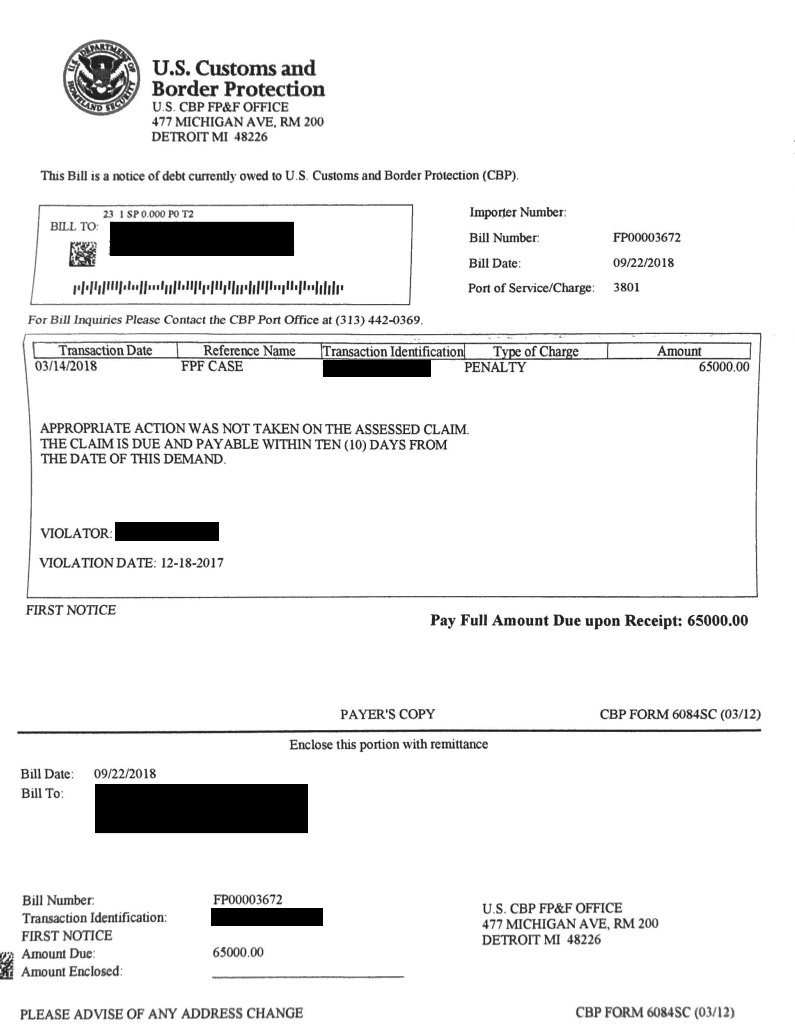
This document is not a penalty notice. It is not a liquidated damages notice. Those documents invite you to file a petition for remission or mitigation — they are the beginning of a dispute process. A CBP bill is different. The debt has already been assessed. There is no offer to contest it through a petition. You are being told to pay, and you are given limited time to do so.
Why Did You Receive a Bill From CBP?
A CBP bill means you owe money to Customs. The most common reasons include:
- Unpaid duties on imported merchandise. Regular tariff duties, Section 301 China tariffs, Section 232 steel or aluminum duties, or antidumping and countervailing duties (AD/CVD) that were not paid at the time of entry — or that CBP has determined were underpaid after a review or audit of your entries.
- Failure to respond to or pay a prior penalty or liquidated damages notice. If you received a penalty notice or a notice of liquidated damages and either ignored it or failed to pay the mitigated amount by the deadline, CBP converts the outstanding amount into a bill for collection.
- Bond violations. Importers who operate under a customs bond can incur liquidated damages for bond condition violations — failure to meet in-bond requirements, entry filing deadlines, or other conditions. When those go unpaid, they become a bill.
- Post-entry adjustments. CBP’s periodic review of entries can result in additional duties being assessed after the fact — particularly for AD/CVD entries subject to annual administrative reviews, or entries where CBP determines the declared value or classification was incorrect.
How to Figure Out What the Bill Is For
The bill itself will contain reference numbers and coding that identify the nature of the debt. Look carefully at the entry number, the port code, the type of debt indicated, and any case or violation reference numbers. Cross-referencing those with your import records or prior CBP correspondence will usually tell you what the underlying transaction is. If you use a customs broker, they should be able to identify the entry and explain what happened.
If you have genuinely no idea why you are receiving a CBP bill — no recollection of the import transaction, no prior penalty or liquidated damages notice, no history with CBP — there are two possibilities. Either you did not receive earlier notices and this is the first communication you are seeing about a debt that has been building for some time, or there is an error in CBP’s records. Neither situation is one to ignore. A CBP debt that goes unpaid does not disappear — it accrues interest, can be referred to Treasury for collection, and can result in garnishment of tax refunds and other collection actions.
What Happens If You Don’t Pay
CBP has significant collection tools available for unpaid debts. If you do not pay or respond, CBP can refer the debt to the U.S. Department of the Treasury for cross-servicing collection, which includes offset of federal tax refunds and other federal payments, referral to private collection agencies, and ultimately litigation in federal district court to obtain a civil judgment. Once a judgment is entered, the government can lien real property, garnish wages and bank accounts, and seize assets. A CBP bill that seems manageable at $5,000 becomes considerably more complicated as a federal judgment with compounding interest and collection costs added on top.
Can You Still Contest the Debt?
That depends on what the debt is for and where you are in the process. If the bill relates to unpaid duties on entries that have already liquidated, the standard remedy is a protest under 19 U.S.C. § 1514, which must be filed within 180 days of liquidation. If the 180-day window has passed, your protest options are significantly limited. If the bill represents a penalty that you failed to respond to at the petition stage, the petition window has likely closed — but in some circumstances there may still be options depending on how far along the collection process is.
If you received a CBP bill and believe the underlying debt is incorrect — wrong classification, wrong valuation, wrong duty rate, misapplied AD/CVD scope, or an error in the records — those are exactly the kinds of issues that warrant legal review. Paying a bill you do not actually owe is not the safe choice; it can be treated as an admission and complicate any subsequent challenge.
What to Do When You Receive a CBP Bill
Do not ignore it. Do not simply pay it without understanding what it is for. And do not assume that because it looks like a utility bill it can be handled the same way. A CBP bill is a federal government debt collection document with legal consequences for non-payment.
The right first step is to identify the nature of the debt, determine whether it is correct, and assess whether any contest options remain available — all of which should happen quickly given the payment deadline on the bill. Great Lakes Customs Law handles CBP penalty defense, duty disputes, protests, and liquidated damages matters. Call us at (734) 855-4999, send a text message, or reach us on WhatsApp. You can also contact us online.