
Summer travel season brings a predictable surge in currency seizures at U.S. airports, and CBP at Washington Dulles International Airport is consistently one of the most active ports in the country for this type of enforcement. Dulles also happens to be one of the most prolific at publicizing its seizures — which gives us useful ground-level detail about how these cases actually unfold.
A recent CBP release covers four separate seizures totaling nearly $130,000 from travelers departing on international flights. The cases involve families heading to Yemen, Egypt, Togo, and Ghana — and together they illustrate three distinct types of currency violations and why each one plays out differently.
The Four Cases
Yemen-Bound Family: $27,560 Split Among Family Members
A family departing for Yemen reported carrying $9,500. CBP officers found the actual total was $27,560 — with the currency distributed among multiple family members. CBP seized the full amount.
This is a textbook structuring scenario. Splitting currency among traveling companions to keep each individual’s share under $10,000 does not avoid the reporting requirement — it makes things worse. Under 31 U.S.C. § 5324, structuring is a separate federal offense from the underlying failure to report. CBP treats the occupants of a traveling group as a single reporting unit. The combined amount they are carrying together is what matters, not what any one person is holding. A family traveling together with $27,560 distributed across four people has $27,560 to report — full stop.
Egypt-Bound Family: $34,283 — K-9 Alert Triggers Discovery
On June 20, CBP currency detector dog Fuzz alerted to an Egypt-bound traveler who had reported carrying $7,000. Officers found $34,283 in currency split among four family members and seized it all.
The K-9 alert is worth noting. CBP deploys currency-detecting dogs at major international airports, including Dulles, and they are effective. A dog alert sends a case immediately into secondary examination and gives officers probable cause to conduct a thorough search. Travelers who might have passed through primary inspection without issue can find their entire luggage and personal items searched based solely on a K-9 alert. The fact that the traveler reported $7,000 — an amount below the threshold — suggests either a belief that staying under $10,000 eliminated the reporting requirement, or a deliberate attempt to underreport. Either way, the result is the same.
Togo-Bound Couple: $15,423 — Declared $9,900
On June 21, a couple departing for Togo declared $9,900. Officers found $15,423 and seized it. Like the Yemen and Egypt cases, this involves a declared amount suspiciously close to the $10,000 threshold — a pattern CBP officers recognize immediately. Reporting just under $10,000 when you are carrying significantly more is treated as an intentional evasion, not an innocent mistake, and it signals awareness of the reporting requirement combined with a deliberate choice not to comply with it.
Ghana-Bound Man: $50,210 — Cash Concealed in Clothing
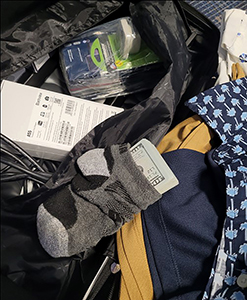
On June 11, a man departing for Ghana reported carrying $45,000 — which would have required a FinCEN 105 filing and would have been perfectly legal. But officers found $50,210 total, with a portion concealed in his clothing. CBP seized the full amount.
This case is categorically different from the other three. The traveler did file a report — he declared $45,000, which is above the threshold and required a FinCEN 105. The violation here is not a complete failure to report; it is the concealment of the additional $5,210. That concealment element transforms this from a simple reporting violation into a potential bulk cash smuggling case under 31 U.S.C. § 5332. Bulk cash smuggling — knowingly concealing currency with intent to evade the reporting requirement — carries significantly harsher consequences than a straight reporting violation, including potential criminal exposure. The fact that he reported most of the money does not insulate him from the smuggling charge on the concealed portion.
What All Four Cases Have in Common
CBP notes that in each case, officers explained the currency reporting law and gave travelers multiple opportunities — both verbally and in writing — to truthfully report the full amount before seizing anything. This is standard procedure at Dulles and most major airports. It matters for two reasons.
First, it means these travelers had a chance to correct their declarations and did not. That fact will be in the seizure record and will be part of what CBP considers when evaluating any petition for return of the funds. A traveler who corrects their declaration when given the opportunity is in a meaningfully better position than one who does not.
Second, none of these travelers were criminally charged — CBP withheld names for that reason. Civil forfeiture and criminal prosecution are separate tracks. The vast majority of currency seizure cases at U.S. airports are handled civilly, not criminally. That does not mean the money comes back automatically. It means the government pursues forfeiture through an administrative process rather than through a courtroom — but the burden is still on the traveler to prove the money was legitimate and the violation was not willful in order to get it back.
A Note on Dulles Specifically
Dulles CBP is among the more aggressive FP&F offices in the country when it comes to how it handles petitions. If you are considering filing your own petition without an attorney — particularly at Dulles — I would strongly urge you to reconsider. The outcome for unrepresented petitioners at Dulles is, in my experience, consistently worse than it needs to be. The FP&F process rewards well-documented, well-argued petitions that address the specific legal standards CBP applies in evaluating violations and mitigation. A letter that simply explains why you needed the money is not the same thing as a legal petition, and Dulles will treat them differently.
Has Dulles CBP Seized Your Cash?
If CBP at Dulles seized your cash, contact us before doing anything else — before calling CBP, before writing a letter, and before attempting to file a petition on your own. Read our customs money seizure legal guide or watch the video series, and reach out for a free consultation using the contact options on this page.